The latest on all kinds of information, news, and resources that help you make working remotely better.
Five Steps To Jumpstart Your Employee Digital Transformation Journey | Anshul Sheopuri, Forbes.com

Transformations rarely achieve their full potential. Being intentional about the accelerators to jumpstart digital transformation of your employee journeys can maximize your chances for success. Here are five steps to get started.
1.Start with the business and user problem.
We all experience products and services with a compelling value proposition day to day, whether it is a smartphone, cloud storage or an electric vehicle. What is common across these is that they solve a user problem differently. For example, as opposed to simply making floppy disks smaller or the experience of transferring data with floppy disks better, cloud storage solutions get to the root of the user problem to store data at scale, securely, seamlessly and at low cost.
2. Create an employee digital storefront to unleash clarity and adoption.
Over the past decade, digital storefronts for customers have mushroomed across a variety of industries. While this has helped obfuscate organizational complexity to customers, in many cases, this has also resulted in too little incentive to simplify organizational structure and organize work around the customer.
3. Activate an operating model with user experience as the clue to galvanize the organization.
Just like software or product organization operating models have become more standardized with the competency areas around product management, development and design, other capabilities that organizations deliver, for example, accounting services, sales operations and human resources, need to operate with clarity of accountability points and structure. This is even more critical in moments of significant change and requires intentional moments of conversation and reinforcement:
• Co-creation with users and stakeholders.
• Continuous improvement with an outside-in lens.
• Candid feedback, creating safe spaces for difficult conversations.
• Celebration, coming together as a team to reflect and celebrate key milestones.
4. Diagnose and instrument root causes versus the symptoms.
Since the root causes span across process, technology and data management, the solutions need to be multifaceted as well, including automated data quality management, defined software testing process and user-centric journeys.
Quick wins matter. Communicate how progress is being made via improvements in data quality. But remember that the right quick wins that address root causes (versus only the symptoms) matter more.
5. Compliance is table stakes – set the bar with voluntary adoption of higher ethical standards.
Taking a compliance-centric approach is table stakes. Set the bar for your organization with voluntary adoption of higher ethical standards to future-proof your posture in line with the organization’s values. While this can feel daunting, remember that companies are at different points in this journey, and it can be helpful to work together to define common standards in new and emerging areas.
Employee journey transformations are a significant opportunity for employee experience and business outcomes. Being intentional about the right stepping stones can maximize the chances of success.
8 Reasons Why You Should Work a Full-Time Job Before Freelancing | Abigale Lim, Makeuseof.com

The allure of freelancing is undeniable. The freedom to work on your terms while earning a high income is undoubtedly appealing. But before you take the plunge into a full-time freelance career, consider the benefits of staying in a nine-to-five job first. Let’s explore why working a traditional full-time job before freelancing can set you up for long-term success as a freelancer.
1.Gain Practical Training
Working in a structured environment allows you to hone these skills. You can learn freelance skills by watching YouTube videos or enrolling in a course. But you’ll gain these skills much faster and get paid while learning if you work a full-time job first.
2. Get Help from Experience Colleagues
In a traditional work setting, you’re surrounded by experienced professionals from diverse backgrounds. Many companies have mentorship programs and feedback systems in place. Leveraging the knowledge and expertise of superiors can benefit your personal and professional growth.
3. Expand Your Network
Working full-time exposes you to a network of professionals. Clients, vendors, leaders, recruiters, and industry peers are your most beneficial professional connections. Building solid relationships with these individuals can open doors to future freelance opportunities.
4. Build Your Emergency Fund
Unstable income is one of the risks of freelancing, especially in the initial stages of your career. Since you don’t have an employee-employer relationship with clients, you can lose your source of income without warning.
A full-time job provides a stable income. It also offers benefits like paid leaves, bonuses, and health insurance plans. As a freelancer, you don’t get paid if you go on vacation. You don’t get paid if you’re sick and can’t work. An emergency fund that will last at least six months will lessen your stress during these moments.
5. Build a Strong Work Ethic
Soft skills such as self-discipline and time management are essential skills of a successful freelancer. As a freelancer, you set your work schedule and choose your projects and clients. It’s easy to procrastinate and lose sight of your workload. The work ethic you develop in your full-time job will be crucial to your success.
6. Learn From Your Mistakes
Working full-time as a young professional provides a safe space to learn and grow from these errors. Many companies offer free training for their employees. Your colleagues and superiors can also provide feedback, helping you avoid similar pitfalls in your future freelance projects.
7. Build Your Portfolio
A diverse and impressive portfolio is a freelancer’s best marketing tool. It attracts potential clients and displays your capabilities. While working full-time, you can work on various projects that can expand your portfolio.
8. Test the Freelance Waters
There are many simple freelancing jobs you can learn easily. Take time to discover the role that fits your skills best. As you gain confidence and experience, you can gradually transition to freelancing full-time.
Embrace the learning opportunities that come with a full-time job. When the time is right, you can venture into freelancing with confidence. If you’re sure that freelancing is for you but can’t let go of the benefits of your traditional job, consider doing both. Holding a freelance job while freelancing as a side hustle works for many professionals.
Tips to avoid loneliness when working from home | Rhymer Rigby, Fm-magazine.com
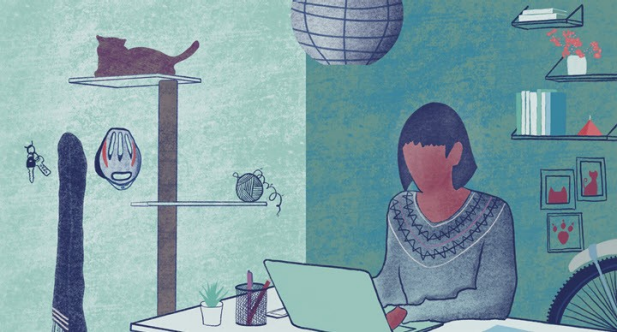
The COVID-19 pandemic accelerated a shift to remote work that was already happening. But while people may love the lack of a commute and the freedom, they may also miss the social side of the office. A 2021 survey of 2,000 UK and US office workers by Kadence, the hybrid workplace software company, found that 81% of workers under the age of 35 and 64% of workers over 35 were concerned about loneliness if they were to continue to work from home full time. Other research has drawn links between tech-enabled distance working and loneliness. So, if you are feeling isolated while working remotely, what can you do about it?
Get outside
If you were at work all day, you wouldn’t just sit at your desk from nine to five. So don’t do this at home. Take a break and get out of your home office.
Set up social media groups
One of the problems with remote work is that you miss the informal chit-chat and serendipitous meetings you have in the office. So, re-create these on social media apps. The ability to make off-the-cuff comments and chat informally is invaluable, and messaging apps significantly reduce the barrier to informal commenting (an email, by comparison, is quite formal).
Attend Zoom or Teams meetings
As much as we can moan about video meetings, they do capture some of the feeling of being together in person. We can see our colleagues and read their facial expressions and feel to an extent that we’re with them.
Make phone calls
The rush to video during the COVID-19 pandemic (and an addiction to messenger apps) means the phone often gets overlooked as a form of communication. But if you have sent a dozen messages or emails, really, you should be making a phone call. It can be far more efficient — if someone doesn’t quite understand what you’re asking, you can clarify what you mean in real time.
Don’t always work at home
Just because you’re working remotely doesn’t mean you always have to be in the spare bedroom. Investigate other options such as coffee shops, co-working spaces, or libraries. These will deliver an office-like experience. And if you go once a week, even if you don’t know people at first, you’ll soon be on nodding terms with other regulars.
Encourage your company to have meetups
There is no substitute for meeting face to face. But the good news is a little goes a long way. You only have to meet up with colleagues once every few months to improve your virtual relationships and make them feel deeper and more meaningful.
Consider a pet
If you’re in it for the long run, a dog or cat can make a big difference — and, what’s more, they’ll never try to micromanage or take credit for your work.
Don’t be afraid to admit you’re lonely
Talking and sharing helps enormously, and you may discover other remote workers have the same problems you have. Your company may also be able to provide you with help under its mental health policy.
Avoid overwork
One of the mistakes many people make when working remotely is believing that they have to fill every moment with work. But you don’t have to use the time you once spent commuting chained to your desk, and you can take a lunch hour. Measure what you do by work output, not hours put in.
Talk to your company about coming in
Employees often ask to be allowed to work from home two or three days a week. So, assuming the office isn’t hundreds of miles away, why not turn this on its head and ask if you can “work from work” once a week? Loneliness can have an enormous negative effect on both your mental health and your productivity. If you are suffering from it, tell your employer. They are likely to want to help in any way they can.
9 pro tips for creatives working from home | Tina Touli, Creativebloq.com

It’s easy to plonk a laptop on the dining table or coffee table and work away, but that probably isn’t going to be comfortable in the long run, and your work may suffer too. Below, the art director and designer Tina Touli offers nine pro tips to consider when honing your home work set up, from your surroundings to your screen (see our pick of the best 4K monitors for options there).
Manage screen brightness
Work in intervals on maximum brightness so that you can get the best out of your colours without damaging your eyes.
Keep organised
Work from everywhere without any technical difficulties by keeping mobile hard drives nice and organised so you can work on your files without taking over your memory!
Invest in a good screen
Your laptop is your friend for when you are out and about, but a great screen will pay dividends when it comes to working in your studio. I recommend a Dell UltraSharp; the colours are so accurate I have barely touched the default settings.
Don’t be afraid of contrast
Don’t be afraid of contrast – Full black or white can be daunting, but be brave! I love high contrast, even B&W, but colours are my favourite. Vivid bright colours.
Light up your room (and your screen)
With bias lighting behind your screen and some clever atmospheric lighting in the room, you can create some separation between work and leisure.
Keep your environment neutral
Keeping your environment neutral can bring out the colour in your work. I tend to keep the studio space more neutral in terms of colour (of course there are little pops of colour around) and even my desktop wallpaper is just a solid grey colour. I feel like it helps me better shape/check the colour palette of every project I am working on.
Listen to music
Science says 60-70 bpm playlists are best to maximise concentration but I love everything from rock music to house. The music I choose depends on my mood, the project I am working on, even the time of the day, but music for working is definitely key.
Print your work
Screens like a Dell UltraSharp allow us to see a lovely range of colours that are super close to what you get on print, something very important for multidisciplinary designers like myself.
Consider a standing desk
Standing desks are your friend, especially if you need to draw on a tablet. I love using a sitting desk when working on the computer but a standing one when I experiment by hand, blending the analogue and the digital worlds (see our guide to the best standing desks for possible options).




 Worksnaps